
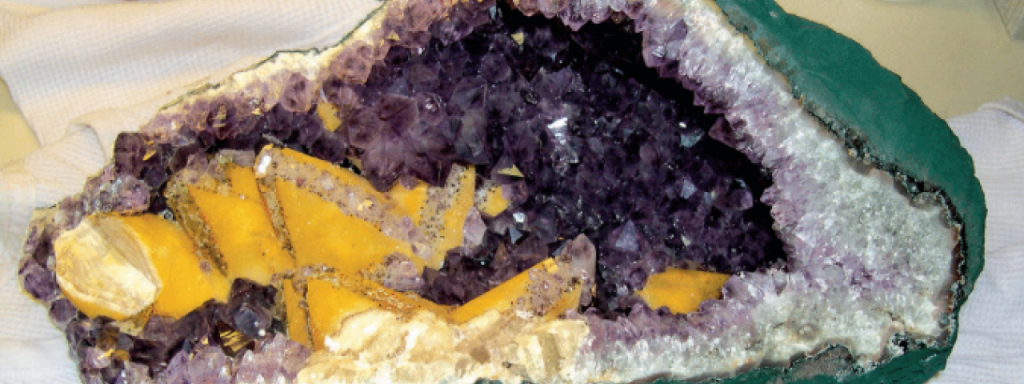
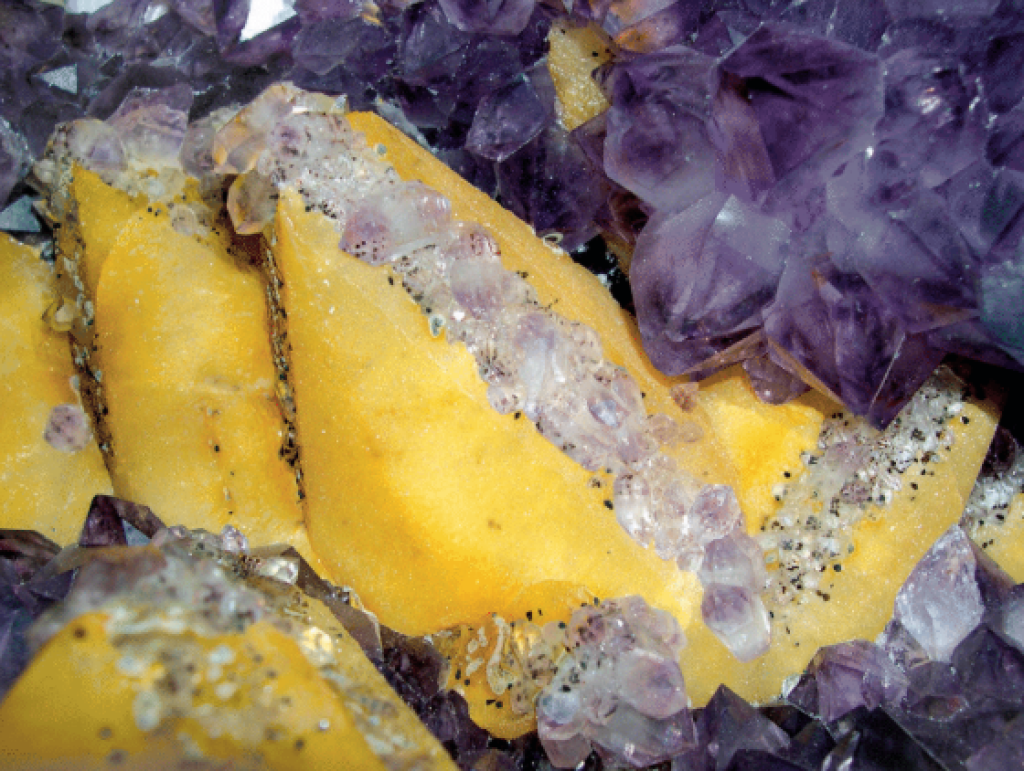
In the vast and intricate world of mineralogy, there exist rare and captivating stories that spark the imagination of collectors and enthusiasts. One such tale is the “Skunk” Calcite, a unique mineral specimen discovered within an amethyst geode from Ametista, Rio Grande do Sul, Brazil.
A Geological Marvel: The Amethyst Geode
The amethyst geode from which the Skunk Calcite was found is a remarkable example of geological formation. This type of crystal-filled cavity is created when superheated water rich in minerals dissolves and redeposits calcium carbonate (CaCO3) crystals within the geode’s quartz-lined walls. The process, known as hydrothermal activity, occurs over thousands to millions of years, allowing for the intricate growth of amethyst crystals.
Mineral Paragenesis: The Story Behind the Skunk Calcite
The Skunk Calcite, with its striking yellow-orange color, was found to have formed through a complex process of mineral paragenesis. This phenomenon occurs when multiple minerals interact and coexist in a specific environment, leading to the creation of unique and often unexpected minerals. In this case, the interaction between manganese (Mn) and iron (Fe) ions with calcium carbonate resulted in the formation of Skunk Calcite.
Discovering the Secret
Researchers and collectors have long been fascinated by the Skunk Calcite’s unusual appearance within the amethyst geode. By studying its crystal structure and chemical composition, scientists were able to unravel the mystery behind this captivating mineral. It is believed that the Skunk Calcite formed through the interaction of manganese (Mn) and iron (Fe) ions with calcium carbonate, leading to its distinctive yellow-orange hue.
The Role of Manganese and Iron
The presence of manganese and iron ions played a crucial role in the formation of Skunk Calcite. These elements are often associated with the oxidation of calcite, which can result in the creation of unique minerals like Skunk Calcite. The interaction between these ions and calcium carbonate led to the development of a distinctive yellow-orange color, making this mineral stand out among its peers.
A Legacy of Discovery
The discovery of the Skunk Calcite within an amethyst geode has left a lasting impact on the world of mineralogy. This unique find has inspired new research and exploration, pushing the boundaries of our understanding of geological processes and mineral paragenesis. The study of this phenomenon continues to captivate scientists and collectors alike, offering insights into the intricate workings of nature.
 The Mineralogical Record
Leave a comment